Tongue Ties
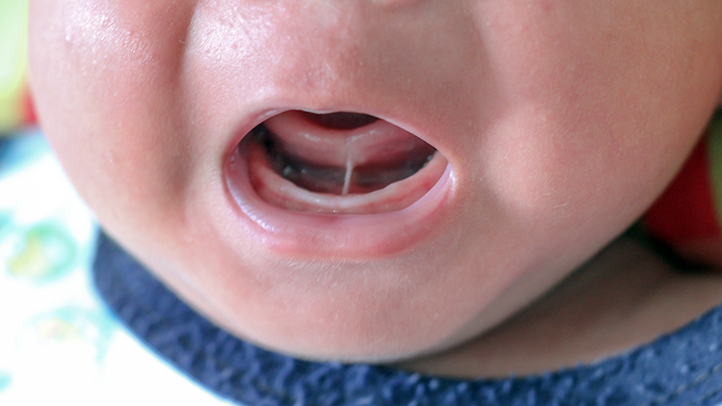
Tongue tie — known medically as ankyloglossia — is a condition present from birth in which a small band of tissue called the lingual frenulum is shorter, tighter, or positioned further forward than usual. This restricts the tongue’s movement and can significantly interfere with a baby’s ability to feed effectively.
To feed well, a baby needs to extend their tongue over their lower gum, create a wide, deep latch, and use a rhythmic wave-like movement to draw milk. This is hard, coordinated work — and the tongue is at the centre of all of it. When tongue movement is restricted, that whole process breaks down. The baby compensates by clamping, chewing, or gripping with their lips, which leads to pain for the feeding parent, inefficient milk transfer for the baby, and frustration for both of you.
This is one of the most important things to understand — and one of the main reasons tongue tie is so frequently missed.
Anterior tongue ties are the most visible. The frenulum runs close to or right to the tip of the tongue, which may look heart-shaped or notched when lifted. These are more likely to be picked up at routine newborn checks.
Posterior tongue ties are far more subtle. The frenulum sits further back under the mucous membrane at the base of the tongue, making it invisible to a simple visual check. The tongue may appear entirely normal at first glance. Yet posterior ties can cause every bit as much feeding difficulty as anterior ones — sometimes more — and are routinely missed by healthcare professionals who haven’t been specifically trained to find them.
This is why a proper, functional assessment — not just a quick look in the mouth — is so important.
No two babies present in exactly the same way, and not every baby with a tongue tie will show every sign on this list. But if several of these resonate with your experience, a tongue tie assessment is absolutely worth pursuing.
Tongue tie is not just a baby problem. It is a feeding problem, and that means your experience matters just as much. Please don’t dismiss your own symptoms.
That last one matters. You know your baby. If your instinct says something isn’t right, trust it and seek an assessment.
A proper tongue tie assessment is nothing like a quick glance in the mouth. It is a thorough, clinical process that takes the whole feeding picture into account — and this is where my background as both an IBCLC and an experienced neonatal nurse makes a real difference.
Your assessment with me includes:
A detailed feeding history. Before I look at anything, I listen. I want to understand your full feeding experience — when difficulties started, what they feel like, what you’ve already tried, and how both you and your baby are coping. This context shapes everything that follows.
Observation of a complete feed. I watch your baby feed in real time — at the breast or bottle — assessing latch, positioning, tongue movement, lip seal, swallowing pattern, and behaviour throughout the feed. This is often where the most important information comes from.
Full oral assessment. I carry out a hands-on examination of your baby’s mouth, assessing the structure and — crucially — the function of the tongue. I assess how the tongue lifts, extends, and moves, not simply how it looks. This is how posterior ties, in particular, are identified.
Clear explanation of findings. I will explain exactly what I’ve found in straightforward language, what it means for your baby’s feeding, and what I would recommend. If a tongue tie is present and affecting feeding, I will discuss division as an option. If I don’t believe intervention is warranted, I will tell you that honestly too — and I’ll explain why.
A written report. You’ll receive a written summary of my assessment findings and recommendations to keep for your own records and share with your GP, health visitor, or midwife if needed.
I normally see babies from birth up to 12 weeks for tongue tie assesment, but I’m happy to carry out assessments and provide feeding support for older babies and children too.
I work with:
If you’re not sure whether a tongue tie assessment is right for your situation, please don’t hesitate to get in touch. A quick conversation is often all it takes to work out the best next step.
You don’t have to keep struggling, and you don’t have to wait and hope things improve on their own. Early assessment and support can make an enormous difference — to your feeding experience, to your baby’s comfort, and to your confidence as a parent.
I offer home visits across East Sussex and Zoom consultations for initial feeding assessments. Tongue tie assessments and divisions are carried out as home visits.